

Photo: Beta/Milan Obradović
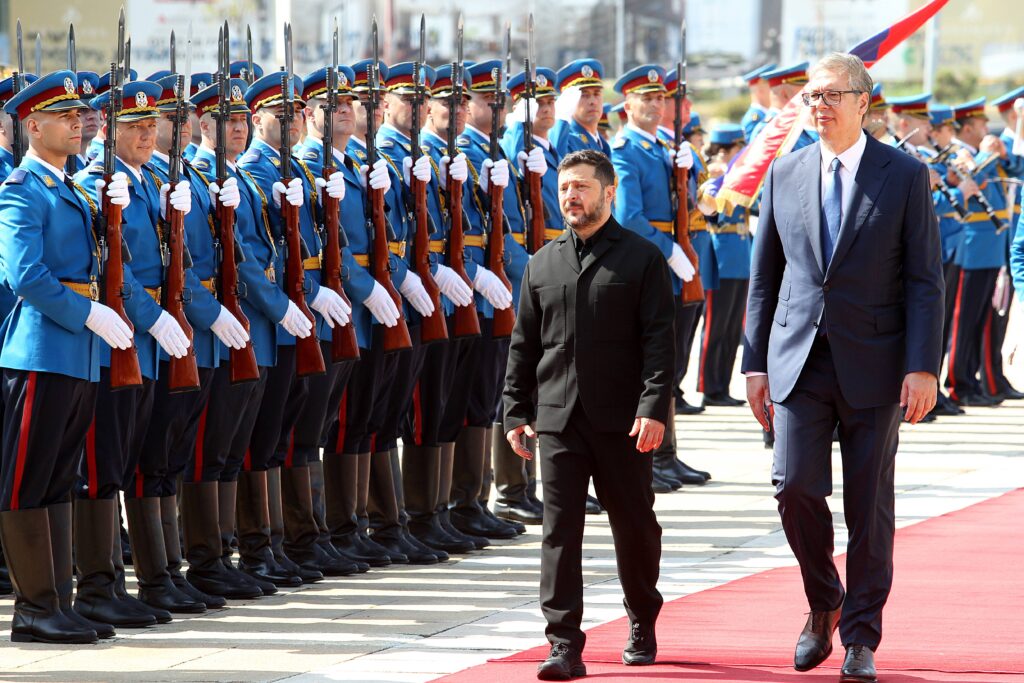
There had been speculation for months about a visit by the President of Ukraine to Belgrade. In the “preparation phase,” there were several high-level contacts between Serbia and Ukraine, from the visit of the Speaker of the Ukrainian Rada (Parliament), Ruslan Stefanchuk, to Vučić’s second participation in the Southeast Europe–Ukraine summit held in Odesa. However, no official bilateral visit had taken place until now. That is why August 8 is an important date for future Ukrainian-Serbian relations. It does not signify a dramatic shift in foreign policy (as someone aptly noted on X: the shift happened long ago; this is merely “boiling the frog”), but rather the opening of new opportunities.
Economy and reconstruction
The logic is straightforward. Despite the war, Ukraine is a country of 40 million people and one of Europe’s larger markets. It is not normal for a country seeking to expand exports and attract investment to ignore it. Although Vučić emphasized during and after his meeting with Zelenskyy that bilateral trade reached around $450 million last year and $321 million in the first six months of this year, these are still relatively modest figures given the size and potential of the two economies. Moreover, trade is not centered on high value-added products but on raw materials and semi-finished goods, primarily iron ore and mineral fertilizers, along with certain agricultural products. Some may recall that Serbian tycoons once bought land in Ukraine, often referred to as the “breadbasket of the world.”
There is another very concrete reason for closer ties. Serbia has been trying for years to complete its accession process to the World Trade Organization (WTO), which is also an important prerequisite for further progress toward European Union membership. The problem is that the WTO operates on the basis of consensus among all members, and bilateral negotiations often have as much political significance as economic significance. This is especially true in the case of Ukraine and Russia. That is precisely why a free trade agreement with Ukraine, should it appear on the agenda, could serve as a tool for resolving outstanding issues. Closer relations with Kyiv can therefore be justified by very tangible national interests.
There is also the question of what happens after the war, whenever it may end. The reconstruction of Ukraine will be one of the largest undertakings in Europe in the 21st century. Even today, for example, Moldova speaks of it as a tremendous development opportunity for the entire region. Serbia, however, faces a perception problem. In much of European public opinion and political circles, Belgrade is viewed as being too close to Moscow. This perception, which we would add is well-earned, could leave Serbian companies excluded from one of the most lucrative future business opportunities. Goodwill gestures that have been undertaken, such as providing assistance to Ukraine’s energy system, will not be enough.
Public diplomacy aside, there is another reality, not particularly well hidden. Ammunition produced in Serbian factories has been reaching the Ukrainian front through intermediaries for several years. This story was first revealed by Western investigative media and gained additional weight last week when former U.S. Ambassador Christopher Hill told Frankfurter Allgemeine Zeitung that the United States had supported the procurement of significant quantities of Serbian ammunition for Ukraine through intermediaries in Poland and the Czech Republic. Hill effectively confirmed that Belgrade knew where the exported goods were ending up. It is difficult to believe such a statement was made without a political assessment that the timing was favorable.
Moscow and balancing
Does this mean Moscow will calmly observe these developments? Probably not. Russia possesses channels of influence in Serbia and could attempt to “send a message” through formal and informal means. However, its options are limited. The media are under government control or influence. Numerous informal groups have been co-opted. Finally, if Russia escalates tensions too much with Belgrade, it risks losing its last partner in Europe.
The fact that, among all possible figures, only Aleksandar Vulin, whose political weight is currently negligible, was chosen to explain to the Russians that the visit occurred under “Western pressure” says a great deal. More likely, the visit was needed at this particular moment by the authorities and by Vučić himself. In the months before the first genuinely competitive and uncertain elections, it buys a little time, understanding, and support. Attention is diverted from the lack of foreign policy alignment, controversial official visits, and the liberal distribution of citizenships.
It will be even easier to explain the visit to domestic voters. The narrative is already prepared, and has been prepared for some time: Serbia pursues an independent and autonomous foreign policy, speaks with everyone, and does not sever relations with any important state. After launching a strategic dialogue with the United States, continuing intensive cooperation with China, and maintaining relations with Russia, hosting Zelenskyy can be presented as yet another example of Serbia’s foreign policy flexibility.
Nor does the opposition have much room to react. It is difficult to gain political advantage by criticizing the arrival of the president of a country that has not recognized Kosovo, with which Serbia seeks to expand trade cooperation, accelerate WTO-related processes, and strengthen its position in European integration. In fact, it is much easier to explain why Zelenskyy came than why he did not come earlier. And in politics, one cannot live off criticism of what happened, or what might have happened.
For all these reasons, this visit should not be interpreted as an abandonment of Serbia’s policy of balancing among major powers. Rather, it can be seen as its logical continuation. Serbia continues to arm Ukraine indirectly while refraining from imposing sanctions on Russia. It develops a strategic dialogue with the United States while simultaneously deepening relations with China. It seeks to become part of European security and defense initiatives while at the same time insisting on a narrative of foreign policy autonomy.
In this context, the question is no longer why Zelenskyy came to Belgrade. The real question is why it took so long for it to happen.
Author: Marko Savkovic, Senior Advisor at ISAC Fund and Assistant Professor at University Union-Nikola Tesla.
Text was first published at Novi magazin’s Internet portal.